
CURRICULUM.
The Maine BIOLAB approach emphasizes the practices of science and engineering, building the critical thinking and problem-solving abilities that are vital for success in these fields. In addition to learning new skills in a hands-on environment, participants will gain a holistic understanding of the bioscience industry and opportunities available to them.
The best part? All Maine BIOLAB lessons are turnkey and free for teachers, promoting inclusivity and accessibility. Climb aboard and join us in shaping the future of science education!
It’s All In Your Head
This activity dives into Newton’s Laws of Motion by having students investigate concussions. Students will investigate the mechanism of concussions and then will use a force plate to measure force and length of impact with different simulated helmet materials to learn how helmets help protect us from traumatic brain injuries.
Next Generation Science Standards Connections:
MS-PS2-1 Apply Newton’s Third Law to design a solution to a problem involving the motion of two colliding objects.
HS-PS2-3 Apply scientific and engineering ideas to design, evaluate, and refine a device that minimizes the force on a macroscopic object during a collision.
Activity Materials for Teachers:
Looking Into Lactase
In this activity, students explore enzyme specificity and reactions between enzymes (lactase specifically) and disaccharide sugars while investigating lactose intolerance. Students explore the biological reasons behind the development of lactose intolerance and learn about and discuss the solutions that humans have developed in response, including milk substitutes and pharmaceuticals.
Next Generation Science Standards Connections:
5-PS1-4 Conduct an investigation to determine whether the mixing of two or more substances results in new substances.
MS-PS1-2 Analyze and interpret data on the properties of substances before and after the substances interact to determine if a chemical reaction has occurred.
HS-LS1-7 Use a model to illustrate that cellular respiration is a chemical process whereby the bonds of food molecules and oxygen molecules are broken and the bonds in new compounds are formed, resulting in a net transfer of energy.
Activity Materials for Teachers:
Maintaining a Balance
In this design engineering challenge, students will discuss ecosystems and species interactions and take part in an invasive species mitigation exercise. Students will put on their engineering hats to assist in maintaining balanced species populations within a model ecosystem. This lesson is best for younger grades.
Next Generation Science Standards Connections:
MS-LS2-4 Construct an argument supported by empirical evidence that changes to physical or biological components of an ecosystem affect populations.
HS-LS2-7 Design, evaluate, and refine a solution for reducing the impacts of human activities on the environment and biodiversity.
Activity Materials for Teachers:
Micropipette Challenge
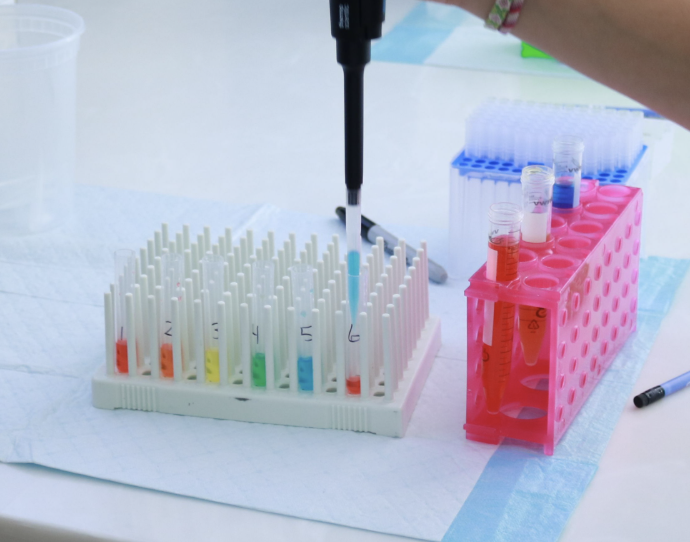
The Micropipette Challenge is a perfect introductory activity, allowing students to gain experience with the tools and techniques, like the micropipette, that are used in many science laboratories. In this lab, students work with small amounts of liquid to create a visible spectrum and practice proper laboratory science procedures and techniques.
Next Generation Science Standards Connections:
Coming soon!
Activity Materials for Teachers:
Parasite Predicament
In this activity, students explore the relationship between antigens and antibodies and how those interactions are used in diagnostic tests, specifically enzyme-linked immunosorbent assays (ELISA). Students will use an ELISA to test a patient sample to determine whether or not the patient has Lyme disease.
Next Generation Science Standards Connections:
HS-LS1-1 Construct an explanation based on evidence for how the structure of DNA determines the structure of proteins which carry out the essential functions of life through systems of specialized cells.
Activity Materials for Teachers:
Water Quality
In this activity, students explore water quality and some of its parameters. Students will discuss why water quality is important and the effects of poor water quality on human needs and ecosystem needs. Students will work together to design filters to determine how different materials are capable of removing pollutants. Once students have filtered their water they are able to test their samples using pH meters and turbidity sensors then they can visualize their samples at a microscopic level using a state of the art fluid imaging system.
Next Generation Science Standards Connections:
MS-LS2-4 Construct an argument supported by empirical evidence that changes to physical or biological components of an ecosystem affect populations.
Activity Materials for Teachers:
What’s In a Change?
This activity offers a deep dive into the difference between physical and chemical changes, guiding students to explore and investigate the key clues that distinguish each. This lab activity will allow students to not only understand the core differences between physical and chemical changes but also gain a newfound appreciation for the subtleties of these processes in the world around them.
Next Generation Science Standards Connections:
5-PS1-1 Develop a model to describe that matter is made of particles too small to be seen.
MS-PS1-2 Analyze and interpret data on the properties of substances before and after the substances interact to determine if a chemical reaction has occurred.
Activity Materials for Teachers:
Where Did the Sugar Go?
In this activity, students become clinical laboratory scientists and are challenged to think about how sugar moves through the body while also considering the various daily considerations a person with diabetes must think about. They learn about the function of insulin in the body, and how a diabetic versus non-diabetic person’s body differs when it comes to insulin. Students conduct a glucose tolerance test on synthetic patient samples to investigate how food consumption and exercise affect blood sugar levels in diabetic and non-diabetic patients.
Next Generation Science Standards Connections:
MS-LS1-3 Use argument supported by evidence for how the body is a system of interacting sub-systems composed of groups of cells.
Activity Materials for Teachers:
Curriculum adapted with permission from Learning Undefeated, all rights reserved.